AI Adoption in Indonesian Financial Services May Not Be a Technology Problem
The real gap of AI adoption in Indonesia's financial services sector and why the first movers won't be the ones with the biggest AI budgets.
A personal observation based on what I've seen across the industry, not a reflection of my employer's views.
AI adoption in Indonesia's financial services sector is still low. Not in terms of interest or investment, but in terms of use cases that run in production and deliver measurable outcomes.
The common assumption is that the technology isn't ready, or that regulation is holding things back. I don't think either of those is the main issue.
The AI tools available today are already capable of multiplying a person's output by two or three times. Not by replacing people, but by handling the research, drafting, analysis, and repetitive tasks while the person acts as validator. That model works. It's proven. And it applies to a wide range of financial services operations.
But most financial services organizations in Indonesia haven't gotten to that point yet. And I think the main reason is this: organizations know they want to use AI, but they haven't figured out where in their processes it fits.
The SOPs exist. The process documentation is there. The missing piece is identifying which specific points in those workflows benefit from AI, why those points and not others, and what the measurable upside looks like.
It's also not a regulatory problem. OJK published its AI Governance guideline for banking in April 2025, covering risk management, implementation standards, and supervision expectations. The regulator is providing a framework, not blocking adoption.
Data privacy adds complexity. Indonesian financial institutions handle sensitive customer data, and many prefer on-premises or private cloud deployments. That's a reasonable preference. It narrows the range of viable tools and stretches timelines, but it's a constraint to work within, not a dead end.
The conditions in Indonesia are favorable. PwC's 2025 survey found that 88% of FSI workers in Indonesia treat failure as a learning opportunity, compared to 54% globally. The appetite at the individual level is there. The gap is in how organizations channel that into structured adoption.
AI has moved past the email-drafting and brainstorming phase. It can be embedded into operational processes and customer-facing workflows where humans validate the output, improving both productivity and service quality. The technology is ready for that.
The missing pieces are process clarity and governance.
The first institutions to move meaningfully won't necessarily be the ones with the biggest AI budgets. They'll be the ones that identify the right insertion points in their processes, build practical internal governance, and give their teams room to experiment.

About the author
Hambali Muslimin
From transforming trade finance and branch operations at Maybank Indonesia to incubating institution-grade financial technology products at GTech Digital Asia.
More about meKeep reading
Related articles
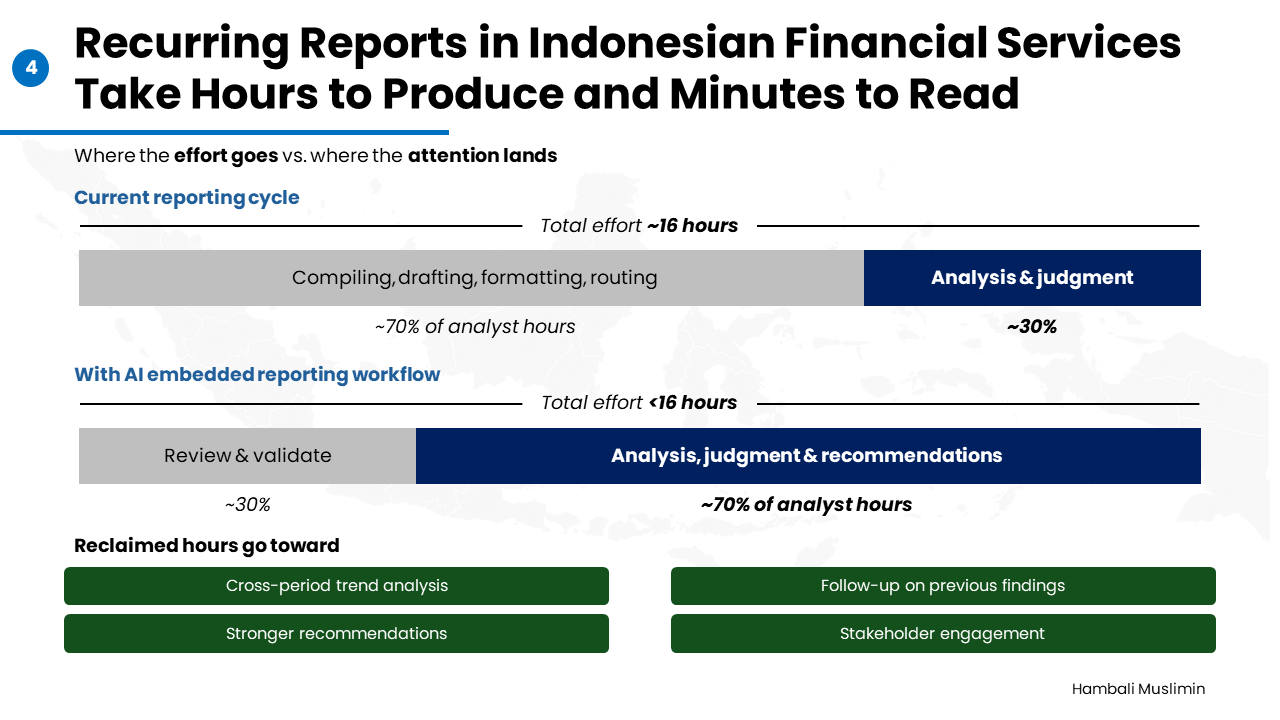
Recurring Reports in Indonesian Financial Services Take Hours to Produce and Minutes to Read
Instead of spending days formatting reports, analysts use AI for drafting and focus on judgment. Organizations gain richer analysis with the same people and schedule.
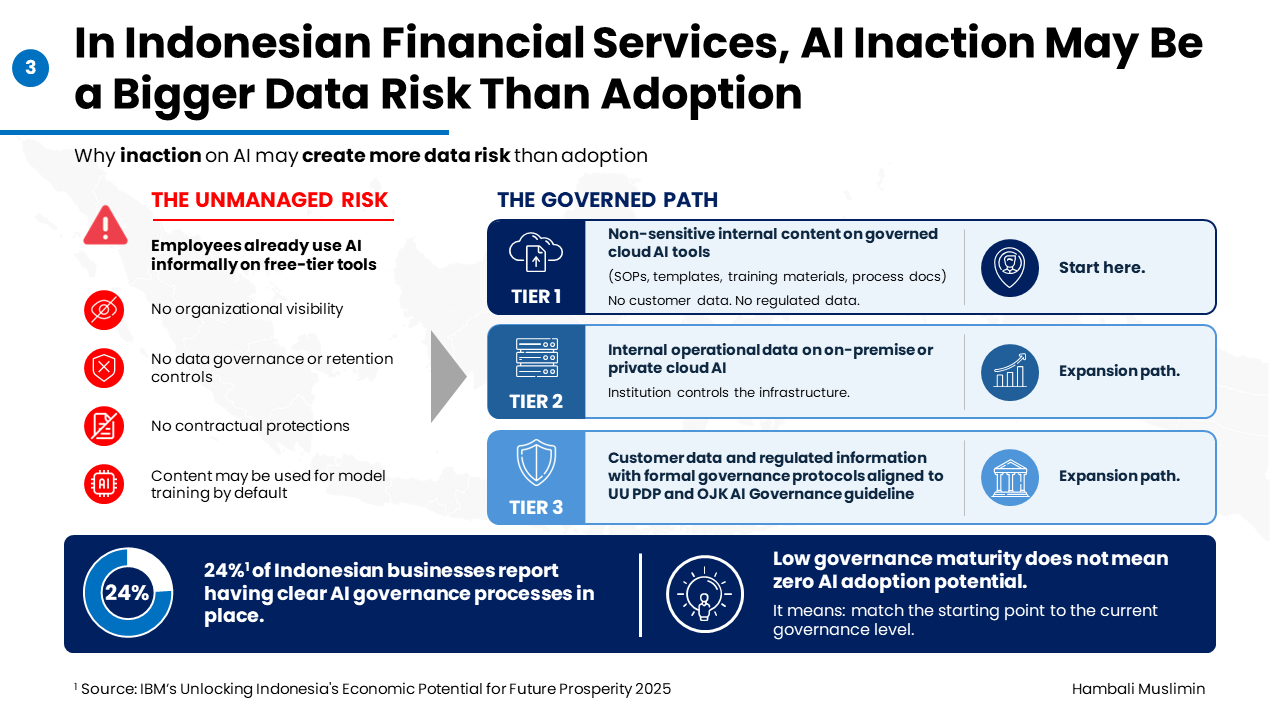
Delaying AI Adoption in Indonesian Financial Services May Be the Bigger Data Risk
While organizations wait for perfect governance. Employees are already using free AI with no data protection & oversight. The real risk isn't starting, it's thinking inaction keeps data safe.
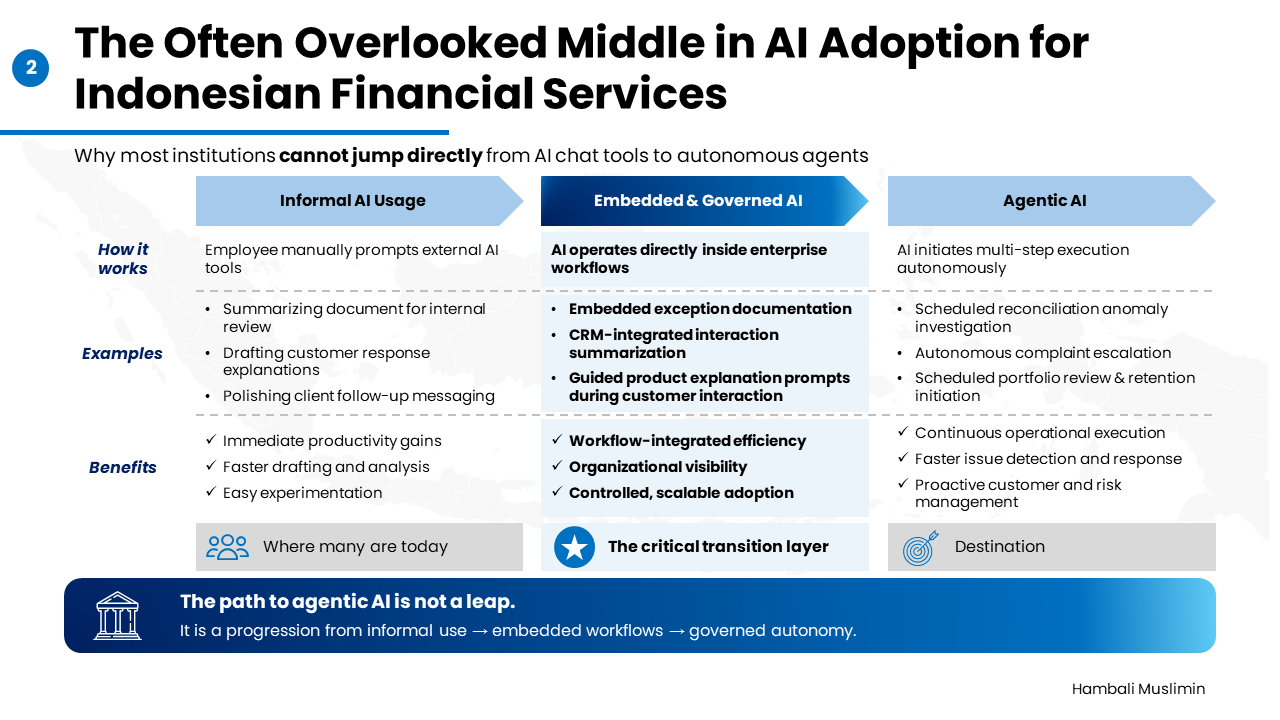
The Step Between ChatGPT and AI Agents That Most Indonesian Financial Services Haven't Taken
There's a step between chat-based AI and autonomous agents that most organizations might have missed. What that step looks like, and what it means for the path to agentic AI.