Recurring Reports in Indonesian Financial Services Take Hours to Produce and Minutes to Read
Instead of spending days formatting reports, analysts use AI for drafting and focus on judgment. Organizations gain richer analysis with the same people and schedule.
A personal observation based on what I've seen across the industry, not a reflection of my employer's views.
Operations and compliance teams at Indonesian banks and insurers produce recurring reports on weekly, monthly, and quarterly cycles.
Risk summaries, branch performance reports, compliance packages, audit findings, claims status documents, underwriting reviews. A single monthly report can take an analyst two full days to produce. In some teams, three or four people touch the same report at different stages. Across a full month of recurring deadlines, the production hours add up.
The attention those reports receive tends to be selective. Readers open the document, check the key figures against the previous period, read the recommendation section, and move on. The narrative sections that took the longest to write get skimmed.
These reports serve their purpose. Institutions require them under internal policy, and regulators set the cadence. The gap is between the effort teams invest in production and the attention each section receives on the other end.
A bank's operations team preparing a monthly risk report goes through a familiar process. The analyst pulls data from three source systems, reconciles the numbers, and drafts the narrative: explanations for each risk category, summaries of mitigation actions, notes on exceptions. She formats the document, inserts charts, and routes it through review. The head of risk scrolls to the executive summary, checks the numbers, reads the escalation flags, and closes the file.
Insurance teams run a parallel cycle. A claims team lead compiles monthly status data across product lines, writes narrative summaries for the claims committee, and formats the output to the standard template. The committee reviews loss ratios and trend numbers. The team has written the narrative in the same structure for years.
Most of the production time goes into tasks that AI handles well.
I wrote in a previous article about AI embedded within enterprise productivity tools, operating inside the working environment rather than in a separate browser tab. That concept applies to reporting.
AI within the analyst's spreadsheet, document, and presentation tools can summarize source data, draft narrative sections, standardize formatting, and compile findings into committee slides. The analyst stays in one connected workflow, with AI assisting at each stage under the institution's data governance controls.
The analyst still owns the report.
She reviews what AI produces, corrects inaccuracies, adds context that raw data doesn't capture, adjusts tone for the audience, and decides what to escalate. AI takes on the assembly and formatting. She spends her time on validation, context, and judgment calls.
The hours she reclaims go toward work the organization needs, but teams lack bandwidth for during production cycles.
She can analyze patterns across multiple reporting periods and surface trends that appear only when you compare several months side by side. She can revisit findings from previous reports and check whether mitigation actions flagged two months ago produced results. She can prepare more considered recommendations based on deeper data review, rather than drafting them in the final hour before submission. She can brief stakeholders on the implications and feed those conversations back into the next reporting cycle.
An operations manager who reviews five monthly reports and finds that three of them now include deeper trend analysis and stronger recommendations is getting more value from the same team. The reporting cadence and headcount stay the same. The quality of the team's output changes.
From a data sensitivity standpoint, most recurring internal reports sit in low-risk territory: operational summaries, performance metrics, and process documentation that doesn't involve customer data.
Teams can start here on governed AI tools. Reports that compile customer information or regulated data require stricter governance, and each institution sets that boundary based on its own risk framework.
Reporting is a practical first use case for AI in operations. The structure is predictable, the inputs are documented, and the output follows a template. This can start without a large-scale transformation project. It does require governed AI tooling, usage guidance for the team, and clear expectations around validation and review.
The reporting workload in Indonesian banks and insurers won't shrink. Regulatory and internal requirements keep producing deadlines on a fixed cadence. Teams can spend fewer hours assembling reports and more hours on the analysis and recommendations that give those reports their value.

About the author
Hambali Muslimin
From transforming trade finance and branch operations at Maybank Indonesia to incubating institution-grade financial technology products at GTech Digital Asia.
More about meKeep reading
Related articles
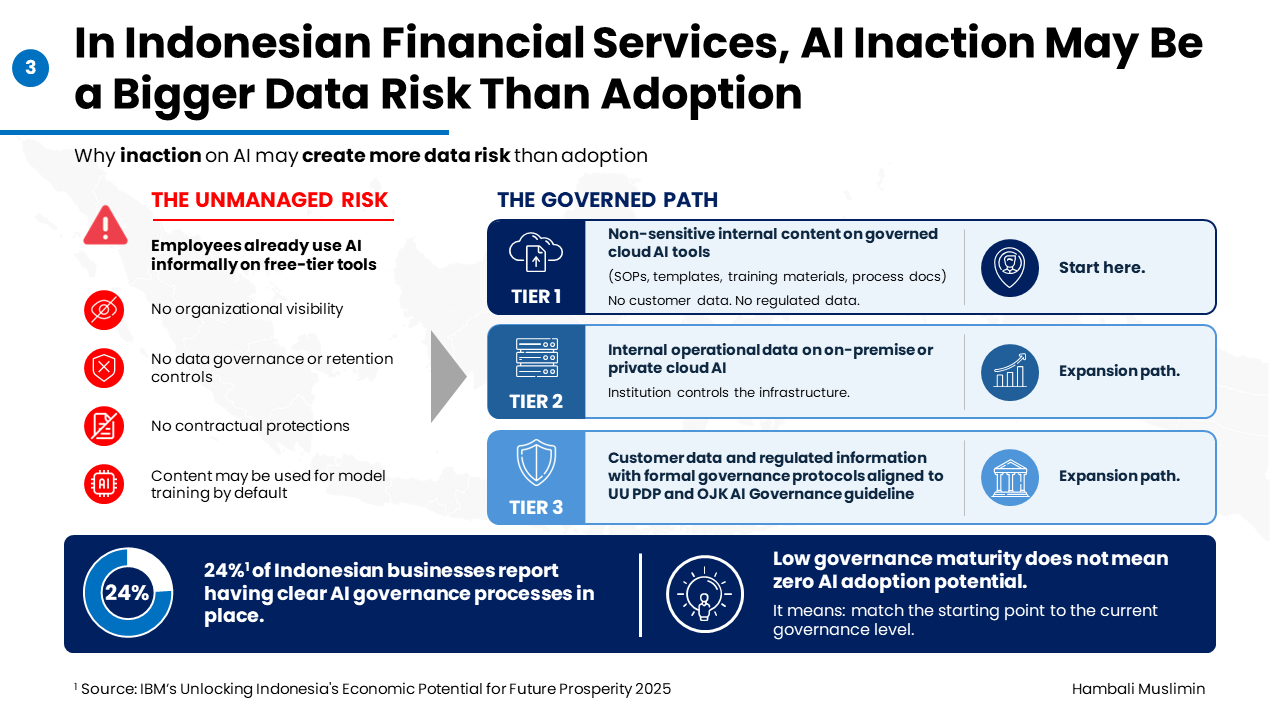
Delaying AI Adoption in Indonesian Financial Services May Be the Bigger Data Risk
While organizations wait for perfect governance. Employees are already using free AI with no data protection & oversight. The real risk isn't starting, it's thinking inaction keeps data safe.
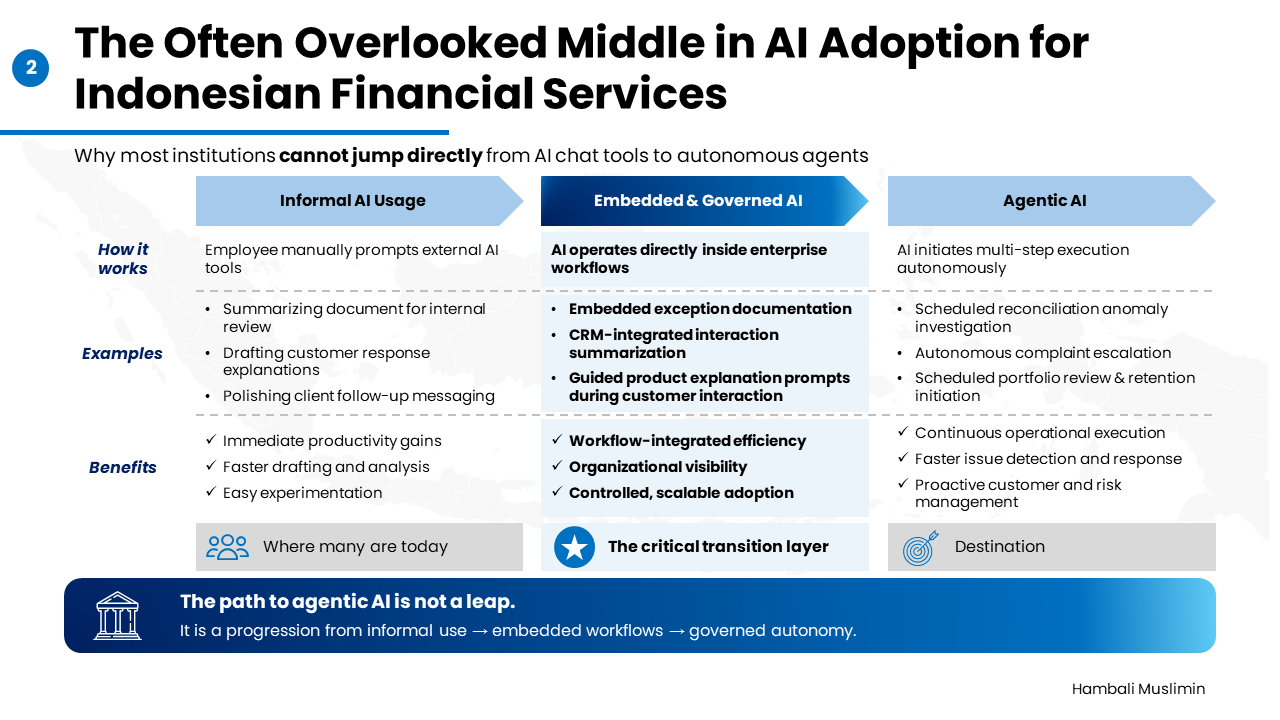
The Step Between ChatGPT and AI Agents That Most Indonesian Financial Services Haven't Taken
There's a step between chat-based AI and autonomous agents that most organizations might have missed. What that step looks like, and what it means for the path to agentic AI.
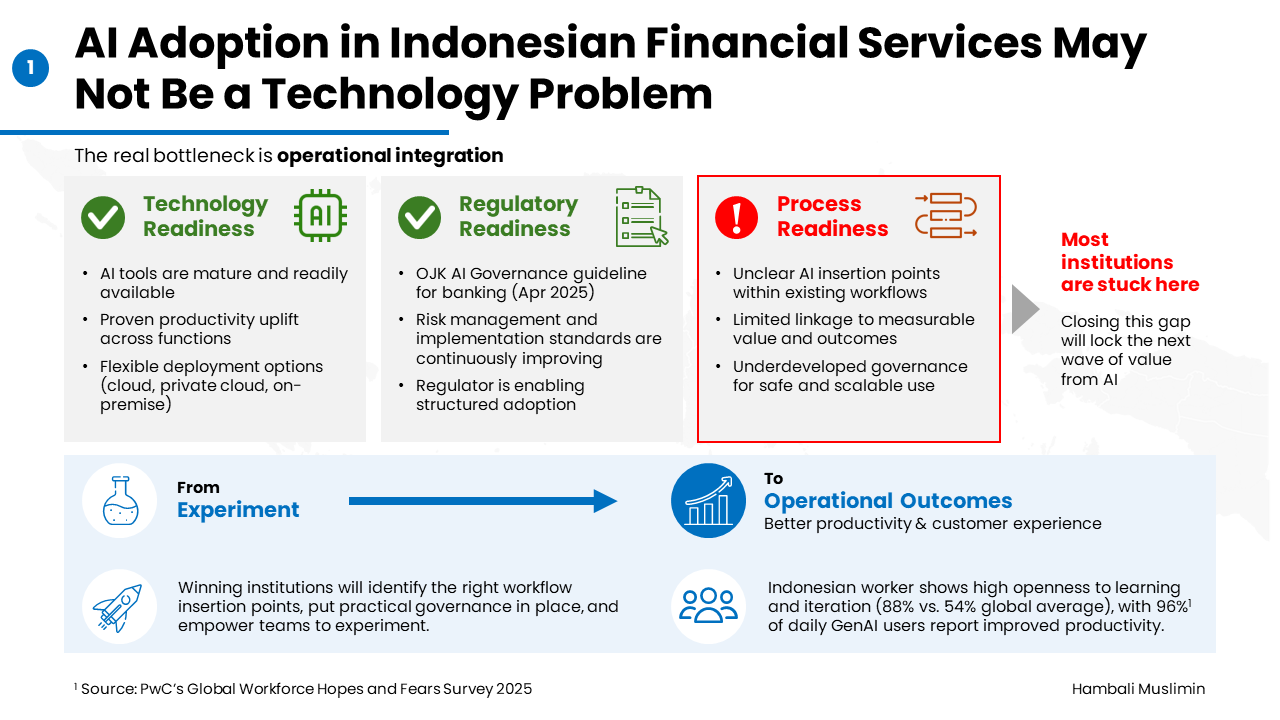
AI Adoption in Indonesian Financial Services May Not Be a Technology Problem
The real gap of AI adoption in Indonesia's financial services sector and why the first movers won't be the ones with the biggest AI budgets.