The Step Between ChatGPT and AI Agents That Most Indonesian Financial Services Haven't Taken
There's a step between chat-based AI and autonomous agents that most organizations might have missed. What that step looks like, and what it means for the path to agentic AI.
A personal observation based on what I've seen across the industry, not a reflection of my employer's views.
A compliance analyst at an Indonesian bank opens a browser tab, pastes a regulatory circular into an AI chat tool, and asks for a summary. The tool returns a structured breakdown in seconds. The analyst copies it into an internal report, adjusts the formatting, and sends it to the team.
That scenario likely plays out across Indonesian banks and insurers today. Professionals use AI tools on their own initiative for drafting and analysis work. The productivity gain is real, but the organization often doesn't see it and therefore can't build on it.
I wrote in my previous article that AI adoption in Indonesian financial services is still low. That observation holds for organizational adoption: production-grade use cases with formal governance and measurable outcomes.
At the individual level, the picture looks different. Professionals have found their own ways to use AI. Most organizations haven't yet captured that usage or channelled it into anything structured.
Industry players, meanwhile, have moved the conversation to agentic AI. Conference agendas increasingly center on it, and vendors pitch autonomous agents that initiate multi-step workflows with minimal human input.
The distance between those two realities is wide.
Most Indonesian financial institutions haven't formalized how their teams use standard generative AI. Jumping straight to autonomous agents skips an important middle layer: AI embedded directly into governed operational workflows.
The difference between generative AI and agentic AI comes down to who initiates the task.
Generative AI, as most financial services professionals use it today, waits for the person. The person opens a tool, enters a prompt, and reviews what comes back.
Agentic AI initiates on its own. A schedule, trigger, or predefined condition sets it in motion, and the AI executes across steps without a direct human prompt.
In financial services, the output would typically sit in a staging state for review before anything critical goes live. The human stays in the loop, but initiation shifts from person to system.
Between those two modes sits a practical step many organizations haven't taken.
Enterprise productivity suites already offer AI embedded within the working environment. Instead of switching to a separate chat window, professionals can prompt AI directly from within their spreadsheet or document tools. The AI executes on the working file itself, and the person reviews the result in context.
The person still initiates the task, but the output lands directly in the actual workflow rather than in a separate browser tab. More importantly, the AI operates within the enterprise environment and under the institution's own data governance controls.
For a bank's operations team preparing monthly risk reports, this means the analyst stays inside the reporting workflow while AI structures data and drafts narrative sections in the same system.
For an insurance team handling policy documentation or claims summaries, the same pattern applies: AI assists inside the document workflow, not outside it.
This often doesn't require a net-new platform or large-scale transformation program. It requires organizations to recognize the informal AI usage their teams already have and move it into governed, embedded tooling. Most enterprise software stacks already support some version of this capability.
Agentic AI demands stronger foundations.
Once AI initiates on its own, the organization needs mapped processes so the system knows what to execute, along with clearly defined boundaries for where its authority ends.
Organizations don't build those foundations by jumping from informal chat usage to autonomous agents. They build them by embedding AI into current workflows and governing the results.
Otoritas Jasa Keuangan’s AI governance guideline for banking, published in April 2025, provides a risk management and implementation framework. That framework becomes increasingly relevant as AI moves from a browser-tab tool to a capability embedded in operational systems.
The pace of agentic AI discussion is accelerating.
The operational reality in Indonesian financial services moves at a different speed, and that's a natural sequence.
The institutions that eventually reach agentic AI capabilities will likely get there by first formalizing the AI their teams already use and embedding it into existing workflows.
Organizations build governance for autonomous systems through that process, not after it.

About the author
Hambali Muslimin
From transforming trade finance and branch operations at Maybank Indonesia to incubating institution-grade financial technology products at GTech Digital Asia.
More about meKeep reading
Related articles
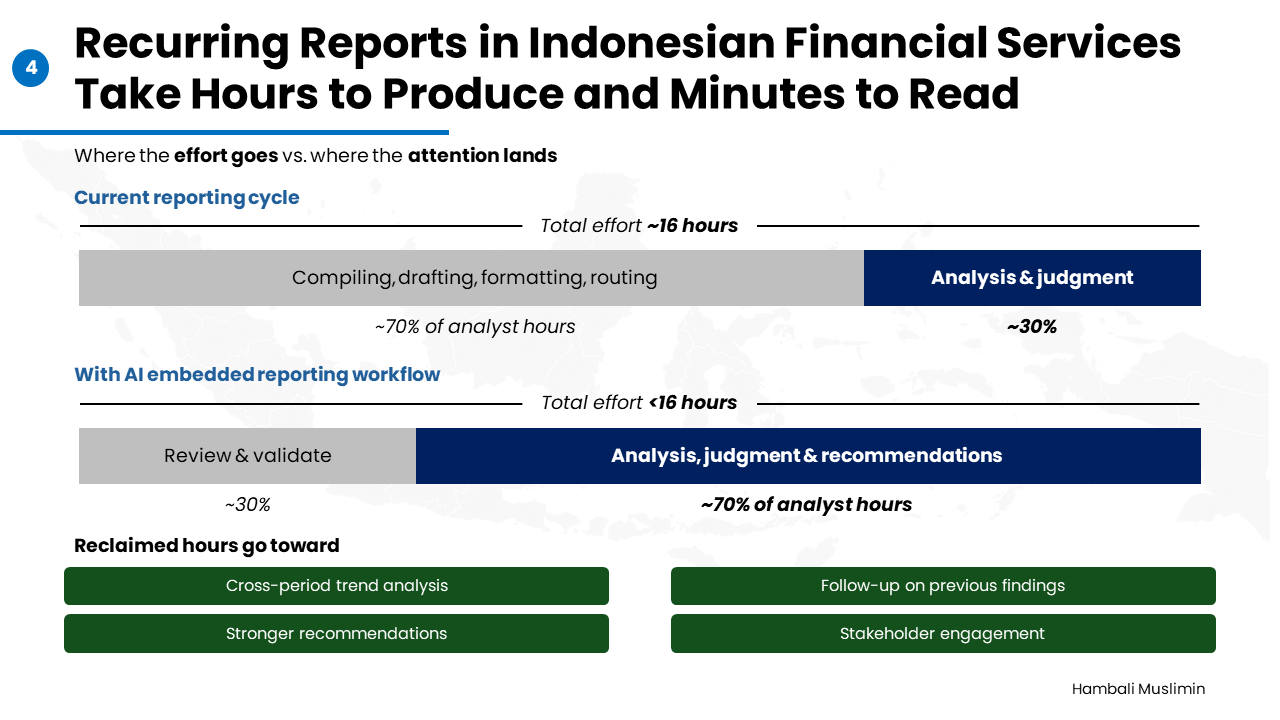
Recurring Reports in Indonesian Financial Services Take Hours to Produce and Minutes to Read
Instead of spending days formatting reports, analysts use AI for drafting and focus on judgment. Organizations gain richer analysis with the same people and schedule.
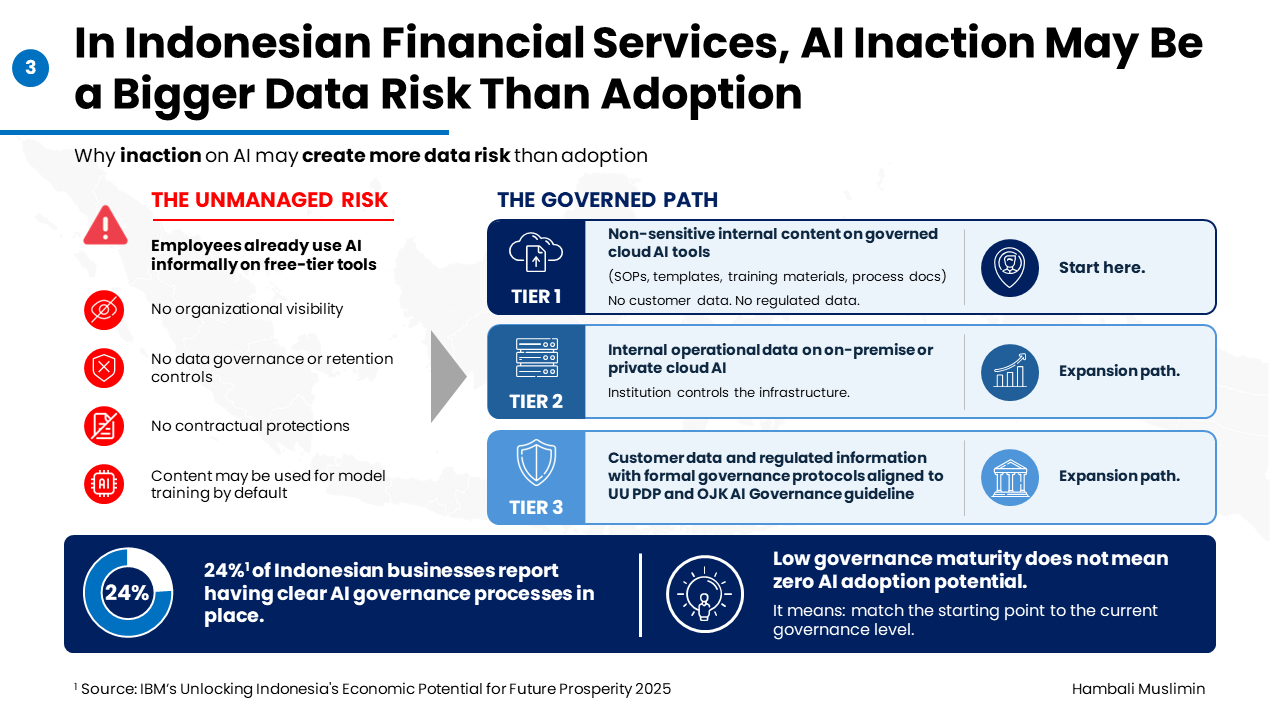
Delaying AI Adoption in Indonesian Financial Services May Be the Bigger Data Risk
While organizations wait for perfect governance. Employees are already using free AI with no data protection & oversight. The real risk isn't starting, it's thinking inaction keeps data safe.
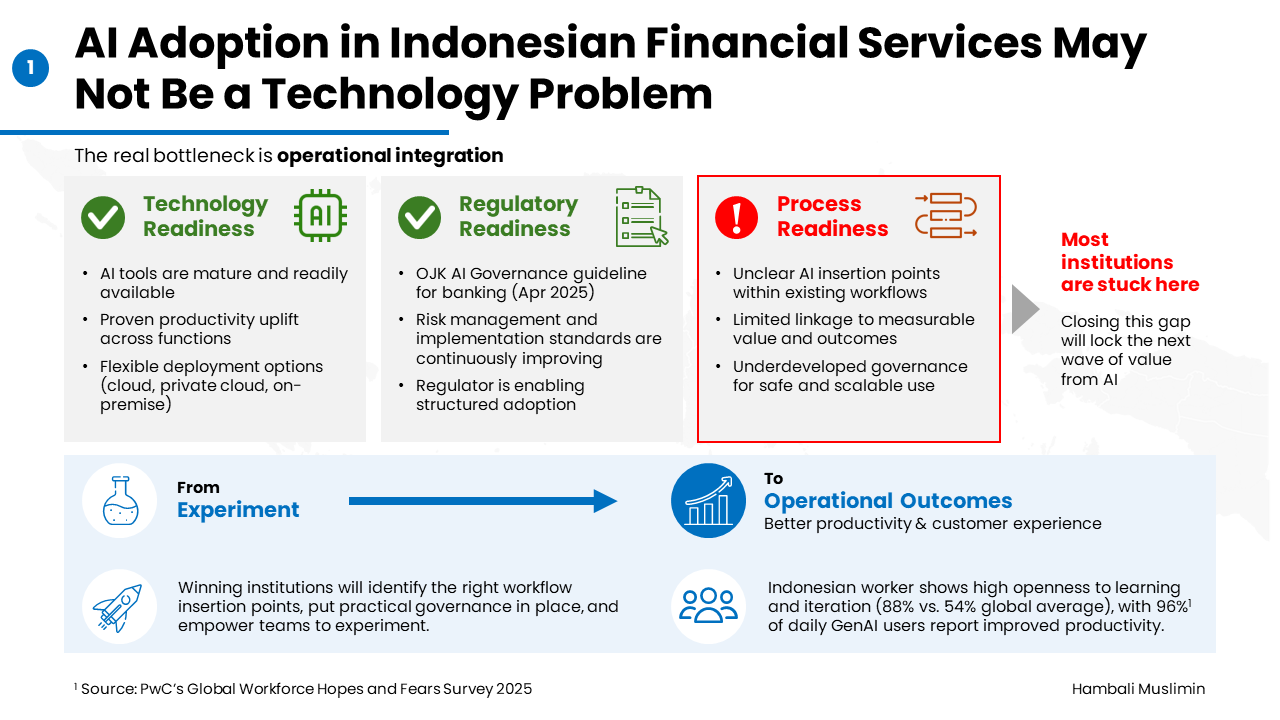
AI Adoption in Indonesian Financial Services May Not Be a Technology Problem
The real gap of AI adoption in Indonesia's financial services sector and why the first movers won't be the ones with the biggest AI budgets.